48% of Breaches Involved a Third Party. Is Your Vendor Ecosystem Being Monitored? According to Verizon's 2026 Data Breach Investigations Report, third-party involvement was identified in 48% of breaches analysed, representing a 60% increase over the previous year's findings. The report also found that vulnerability exploitation accounted for 31% of breaches, surpassing stolen credentials as the leading initial attack vector.
These findings highlight a critical weakness in enterprise security: the attack surface no longer ends at the organisation's own infrastructure.
Cloud service providers, SaaS platforms, managed security providers, software vendors and outsourced IT partners are deeply integrated into business operations. They process sensitive information, maintain infrastructure, access internal systems and support critical applications. Each connection introduces an external dependency that can affect the organisation's security posture.
A vendor with compromised privileged credentials can provide an attacker with access to connected environments. A vulnerable software dependency can introduce exploitable code into production systems. An insecure API integration can expose data across organisational boundaries.
The security of your organisation is directly influenced by the security controls governing its external relationships.
This makes Third-Party Cybersecurity Risk Management a core component of enterprise security governance. It requires organisations to identify external dependencies, evaluate vendor security controls, understand potential attack paths and continuously monitor changes that could increase exposure.
The challenge is not simply to determine whether a vendor is secure at the time of onboarding. It is to establish whether the vendor can consistently protect the systems, information and business processes entrusted to it.
Understanding Supply Chain Cybersecurity Risks Across Your Vendor Ecosystem
A vendor ecosystem includes more than the suppliers listed in a procurement database. It encompasses every external entity, technology component and service dependency that contributes to the delivery of business operations.
A typical enterprise may depend on:
-
Cloud infrastructure providers hosting business-critical workloads.
-
SaaS platforms integrated with internal applications.
-
Managed service providers with remote or privileged access.
-
Software vendors supplying applications and third-party libraries.
-
Payment gateways processing financial transactions.
-
Outsourced development and support teams.
-
Subcontractors responsible for infrastructure, data processing or technical operations.
These relationships create interconnected trust boundaries. A security weakness within one provider can affect multiple downstream organisations, particularly when shared infrastructure, software components or privileged access mechanisms are involved.
The risk extends beyond direct vendors
Consider a SaaS provider that hosts enterprise information on a cloud platform, uses outsourced support personnel, integrates open-source software components and relies on another service provider for infrastructure maintenance.
Your organisation may have completed a third-party security assessment of the SaaS provider. However, that assessment may not provide sufficient visibility into the security controls governing its subcontractors and underlying technology dependencies.
This introduces fourth-party risk, where an organisation's exposure originates from the vendors and service providers supporting its direct suppliers.
The resulting supply chain cybersecurity risks can emerge through several attack paths:
-
Software supply chain compromise: Attackers exploit vulnerabilities or compromise software development, build and distribution processes to introduce malicious or vulnerable components into trusted applications.
-
Shared infrastructure exposure: A security incident affecting a cloud provider or shared technology platform can create operational and data exposure across multiple customers.
-
Third-party identity compromise: Stolen credentials, weak authentication or excessive privileges can allow attackers to misuse vendor accounts and access connected enterprise systems.
-
Insecure integrations: Weak API authentication, inadequate authorisation controls and excessive data permissions can expose information across interconnected applications.
-
Fourth-party dependencies: Undisclosed subcontractors or inadequately assessed service providers can introduce security weaknesses outside the organisation's direct oversight.
The NIST Cybersecurity Supply Chain Risk Management: Due Diligence Assessment Quick-Start Guide, SP 1326, published in July 2026, provides a practical approach to supplier due diligence. Developed in alignment with NIST SP 800-161 Rev. 1, it identifies key areas organisations should investigate before making supplier-related acquisition decisions.
These include Foreign Ownership, Control or Influence (FOCI), supplier and product provenance, resilience, foundational cybersecurity practices, and supply-chain tiers.
The guidance reinforces an important principle: supplier assessment should examine more than declared security controls. Organisations also need to understand the supplier's background, dependencies, operational resilience and potential exposure across the supply chain.
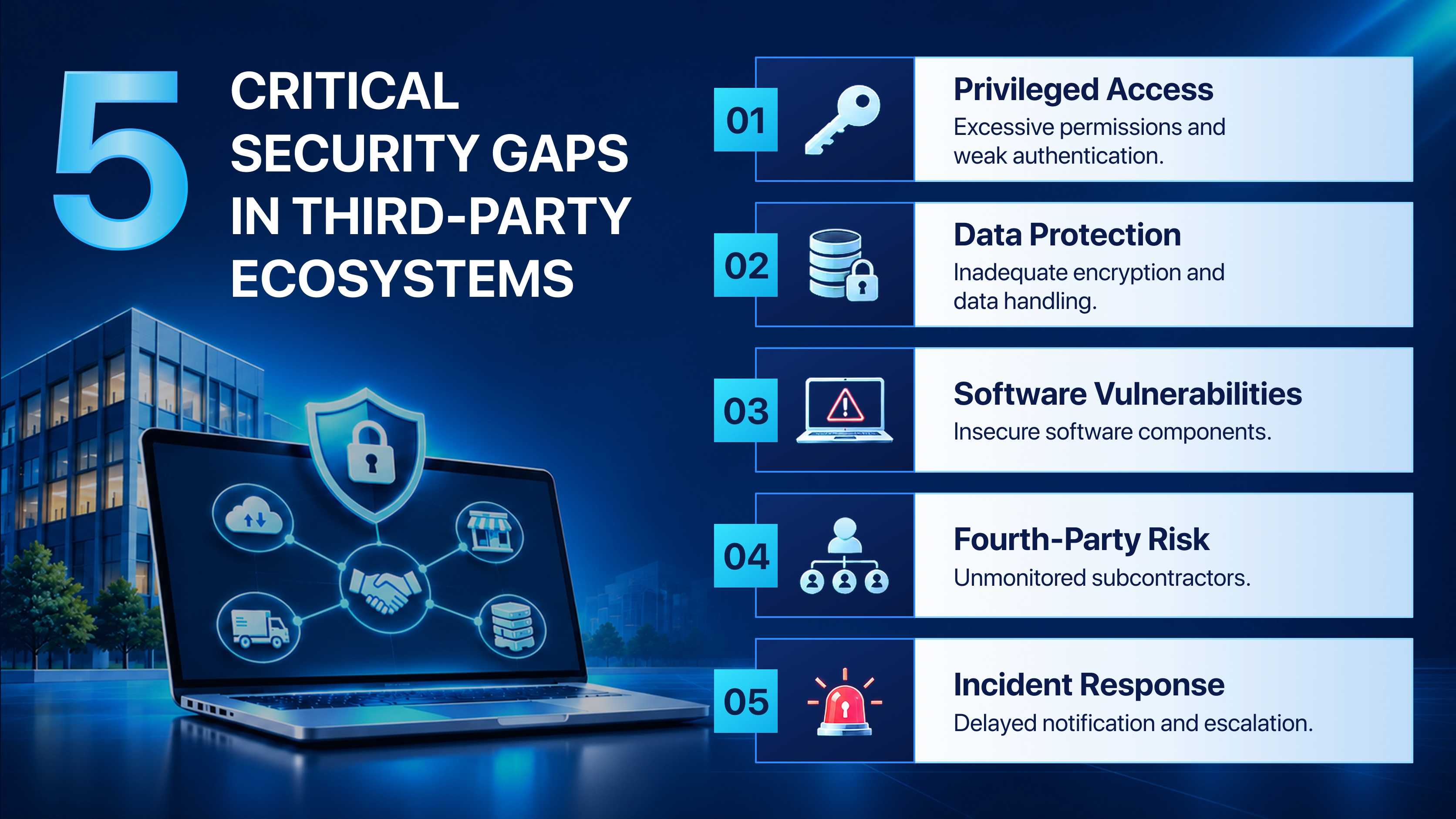
Five Critical Security Gaps in Third-Party Ecosystems
Vendor-related security exposure often develops through routine operational activities. Access permissions change, new integrations are deployed, software components are updated and subcontractors are introduced.
Without appropriate oversight, these changes can create weaknesses across the extended enterprise.
1. Excessive Privileged Access and Identity Exposure
Third-party personnel frequently require access to internal applications, cloud consoles, databases, remote management tools and administrative interfaces.
The risk increases when access permissions exceed the operational requirements of the service.
Common weaknesses include:
-
Shared or generic vendor accounts that reduce individual accountability.
-
Privileged accounts without multi-factor authentication (MFA).
-
Excessive permissions that violate the principle of least privilege.
-
Inactive accounts that remain enabled after personnel or contract changes.
-
Remote access channels without adequate session monitoring.
-
Infrequent access recertification and entitlement reviews.
A compromised vendor identity can provide an attacker with the permissions assigned to that account. Depending on network architecture and access segmentation, this may support lateral movement into connected systems.
Security controls to prioritise:
Enforce MFA, implement role-based access control (RBAC), use privileged access management (PAM) for administrative accounts and maintain individual user identities. Apply just-in-time or time-bound access where operationally feasible. Vendor permissions should be reviewed periodically and revoked when the business requirement ends.
2. Inadequate Data Protection and Information Handling
External providers may process personally identifiable information, financial records, authentication data, intellectual property and confidential business information.
Organisations must understand how this information is collected, transmitted, stored, accessed, retained and deleted throughout the vendor relationship.
A technical assessment should examine:
-
Encryption of data at rest and in transit.
-
Cryptographic key management and access to encryption material.
-
Data segregation in shared or multi-tenant environments.
-
Access restrictions for vendor personnel and subcontractors.
-
Data retention, archival and secure deletion mechanisms.
-
Data residency and cross-border processing arrangements.
-
Logging and monitoring of access to sensitive information.
A vendor's statement that data is encrypted does not establish whether encryption is consistently enforced across all relevant systems. Organisations should evaluate the encryption standards, key ownership, key rotation procedures and privileged access controls supporting the service.
Security controls to prioritise:
Define data classification and handling requirements, enforce encryption standards, validate key management practices, restrict access according to business need and establish verifiable retention and secure deletion procedures.
3. Vulnerable Software and Third-Party Components
Enterprise applications depend on external libraries, frameworks, APIs, container images and software packages. A vulnerability within one component can affect multiple applications and downstream users.
This creates a software supply chain risk that cannot be addressed through conventional infrastructure security assessments alone.
The assessment should consider the vendor's Software Development Lifecycle (SDLC) and vulnerability management practices, including:
-
Secure Software Development Lifecycle (SSDLC) controls.
-
Software composition analysis and dependency management.
-
Vulnerability identification and risk-based prioritisation.
-
Patch management and remediation timelines.
-
Security testing before production deployment.
-
Code integrity and software release controls.
-
API authentication, authorisation and input validation.
A Software Bill of Materials (SBOM) provides an inventory of software components included in a product. It supports vulnerability correlation by helping organisations identify whether a disclosed vulnerability affects a component used within a deployed application.
However, an SBOM is not proof of software security. Its effectiveness depends on accuracy, completeness, update frequency and the ability to correlate components with relevant vulnerability intelligence.
Security controls to prioritise:
Request relevant software composition information, review vulnerability disclosure and patch management procedures, evaluate secure development practices and establish remediation expectations for critical software vulnerabilities.
4. Unmonitored Subcontractors and Fourth-Party Dependencies
A vendor's security controls do not automatically extend to every organisation involved in delivering its services.
Subcontractors may host infrastructure, process sensitive information, provide remote support or maintain production environments. If these relationships are not disclosed and assessed, they can create unaccounted attack paths.
A third-party security assessment should examine:
-
The identity and role of material subcontractors.
-
The systems and information accessible to each subcontractor.
-
Security requirements imposed through downstream contracts.
-
Access provisioning and revocation procedures.
-
Incident notification and escalation responsibilities.
-
Changes in critical supply chain dependencies.
Organisations should also establish whether vendors can introduce new subcontractors without prior notification, approval or security review.
Security controls to prioritise:
Maintain visibility into material fourth parties, define flow-down security obligations, establish subcontractor approval requirements and reassess dependencies when significant changes occur.
5. Delayed Incident Notification and Limited Response Coordination
A security incident involving a vendor can create operational, financial and regulatory consequences for its customers. However, the organisation may not be able to investigate or contain the exposure effectively if the provider does not communicate the incident promptly.
The risk becomes more serious when contractual obligations do not define notification timelines, evidence-sharing requirements or incident coordination responsibilities.
Vendor assessments should establish whether the provider has:
-
Documented incident response procedures.
-
Defined escalation paths and accountable contacts.
-
Security event logging and evidence retention.
-
Processes for identifying affected systems and data.
-
Forensic investigation and containment capabilities.
-
Business continuity and recovery arrangements.
-
Defined customer notification procedures.
Security controls to prioritise:
Establish contractual incident notification requirements, define escalation procedures, agree on investigation responsibilities and ensure the vendor can preserve and provide relevant evidence.
Regulatory Requirements for Third-Party Cybersecurity Risk Management
Third-party security is not limited to internal IT governance. In India, it also intersects with cybersecurity audit expectations and sector-specific regulatory requirements.
CERT-In and the Reserve Bank of India provide important references for organisations assessing external service providers. Their applicability depends on the nature of the organisation and the regulatory framework governing it.
CERT-In: Third-Party Risk as Part of Cybersecurity Audits
CERT-In's Comprehensive Cyber Security Audit Policy Guidelines, 2025 identify third-party risk assessment, vendor risk assessment and supply chain risk assessment among the areas to be considered during cybersecurity audits.
This reinforces the need to evaluate external dependencies as part of an organisation's overall security posture.
An audit focused exclusively on internally managed infrastructure may overlook exposures introduced by vendors with access to critical systems, sensitive information or operational environments.
Organisations should examine relevant security deficiencies, document audit findings and track corrective actions through closure. Vendor security evidence and remediation records should form part of the broader cybersecurity audit and assurance process.
RBI: Third-Party Cybersecurity and Outsourcing Requirements
The Reserve Bank of India's Commercial Banks (Cybersecurity, Technology: Risk, Resilience and Assurance Framework) Directions, 2026, issued on 31 July 2026 and updated on 1 October 2026, establish specific requirements relating to third-party arrangements within the IT and cybersecurity ecosystem.
Paragraphs 126–135 address third-party arrangements that fall outside the scope of the RBI's separate 2025 outsourcing directions.
The framework requires applicable banks to establish vendor risk assessment processes and controls proportionate to the assessed risk and materiality of third-party arrangements.
Key requirements include:
-
Mitigation of vendor concentration risk and single points of failure.
-
Effective management of supply chain risks.
-
Comprehensive risk assessment before engaging critical vendors.
-
Regular due diligence, oversight and management of service providers.
-
Policies and procedures to evaluate, approve, review, control and monitor vendor arrangements.
-
Contractual audit rights for banks and inspection rights for the RBI.
-
Appropriate assessment of third-party personnel accessing or managing critical bank assets.
-
Background verification, non-disclosure agreements and security policy compliance requirements for third-party service providers.
The framework also makes clear that banks remain accountable for managing security risks in outsourced and partner arrangements.
For organisations handling regulated banking operations, this reinforces the need for documented vendor assessments, ongoing oversight and demonstrable security assurance.
The RBI's Commercial Banks (Managing Risks in Outsourcing) Directions, 2025 should also be considered for outsourcing arrangements within their scope. These directions address service-provider evaluation, outsourcing agreements, monitoring and control, information security, business continuity, disaster recovery and exit strategies.
Applicability matters: The 2026 cybersecurity framework's commercial-bank provisions apply to the specified commercial banks. Its paragraphs 126–135 expressly exclude third-party arrangements covered by the 2025 outsourcing directions. Organisations should identify which RBI requirements apply to their entity and arrangement rather than treating the two directions as interchangeable.
DSCI: Vendor Risk and Cybersecurity Readiness in India's BFSI Sector
The Data Security Council of India's State of Cybersecurity Readiness in BFSI Sector India, published in May 2026, examines cybersecurity maturity across India's banking and financial services ecosystem.
The report highlights evolving threat patterns and sector-wide maturity gaps. It identifies inconsistencies in governance, vendor risk management and incident response across the broader BFSI ecosystem, even as leading institutions adopt more advanced security practices.
This is particularly relevant to organisations operating interconnected financial technology ecosystems, where external service providers, cloud platforms and technology partners can influence the security of critical business operations.
The findings reinforce the need to move beyond periodic vendor questionnaires towards structured third-party assessments, evidence-based control validation and continuous oversight of material service providers.
How to Conduct an Effective Vendor Risk Assessment
An ISO 27001 certificate or SOC 2 report can provide useful assurance about a provider's information security controls. However, neither should be treated as conclusive evidence that every service, system or integration used by the vendor is secure.
The assessment must establish whether the controls are relevant to the specific service being procured, whether they operate effectively and whether they address the organisation's risk exposure.
A meaningful vendor risk assessment should examine the following control domains.
-
Identity and Access Management: Evaluate authentication mechanisms, privileged access, role-based permissions, account lifecycle management, MFA enforcement and access review procedures.
-
Data Security and Privacy: Assess encryption, key management, data segregation, information handling, retention, secure deletion and access to sensitive information.
-
Security Operations: Review security monitoring coverage, log management, alert triage, threat detection capabilities and incident escalation procedures.
-
Vulnerability and Patch Management: Examine vulnerability scanning frequency, risk-based prioritisation, remediation SLAs, penetration testing and software dependency management.
-
Application and API Security: Evaluate secure development practices, API authentication and authorisation, input validation, security testing and release management.
-
Incident Response: Assess incident classification, response playbooks, escalation timelines, forensic readiness, evidence preservation and customer notification procedures.
-
Business Continuity and Disaster Recovery: Review recovery objectives, backup protection, restoration testing, resilience arrangements and service continuity dependencies.
-
Subcontractor Security: Identify downstream providers, assess their access and data processing responsibilities, and review how security obligations are enforced across the supply chain.
Validate Control Effectiveness, Not Just Control Existence
A vendor questionnaire may indicate that MFA is enabled or vulnerability scanning is performed. That response does not establish whether the control is consistently enforced or operating effectively.
Where the vendor's risk profile warrants it, organisations should request supporting evidence such as:
-
Relevant audit reports and independent assurance findings.
-
Vulnerability assessment and penetration testing summaries.
-
Security policies and control implementation records.
-
Access review and privileged account management evidence.
-
Incident response and business continuity test results.
-
Vulnerability remediation records and exception approvals.
The depth of evidence validation should reflect the vendor's criticality, access privileges, data sensitivity and operational dependency.
A provider hosting critical workloads requires more scrutiny than a supplier with no access to sensitive information or business systems.
The objective is to determine the effectiveness of the controls protecting the service, not simply to accumulate compliance documents.
Third-Party Risk Management Solutions: Building a Secure Vendor Lifecycle
A vendor passing its initial assessment does not establish that its security posture will remain acceptable throughout the relationship.
Infrastructure changes, new integrations, personnel transitions, software vulnerabilities and subcontractor additions can alter the organisation's exposure.
Third-Party Cybersecurity Risk Management must therefore operate across the complete vendor lifecycle, from initial identification and due diligence to ongoing monitoring and secure offboarding.
1. Establish a Complete Vendor Inventory
A reliable risk management process begins with visibility into the external entities connected to the organisation.
Maintain a central inventory of providers, including:
-
Services and business functions supported.
-
Systems, applications and infrastructure accessed.
-
Data categories processed or stored.
-
Privileged and remote access permissions.
-
Subcontractors and material dependencies.
-
Contractual and regulatory obligations.
-
Business owners and security contacts.
The inventory should cover cloud platforms, SaaS applications, managed service providers, software suppliers and other relevant technology partners.
Where possible, reconcile procurement records with identity systems, application inventories and cloud access records. This helps identify technology relationships that may not be captured through formal procurement channels.
2. Classify Vendors According to Business and Security Impact
Applying the same assessment depth to every supplier creates unnecessary administrative effort and can divert attention from high-impact dependencies.
A risk-based classification model should consider data sensitivity, system access, operational criticality, external connectivity and regulatory relevance.
| Risk level | Vendor examples | Required oversight |
|---|---|---|
| Critical | Cloud infrastructure, payment processing, core business platforms | Detailed security assessment, enhanced monitoring, periodic reassessment and exit planning |
| High | Managed IT services, sensitive data processors | Structured control assessment, evidence validation and scheduled reviews |
| Medium | Business applications with limited access | Standard assessment, access review and periodic security checks |
| Low | Suppliers with minimal system or data access | Basic due diligence and contractual safeguards |
Classification should be reviewed when the service scope, access privileges, data processing activities or operational dependency changes.
3. Define Security Requirements Before Contract Execution
Security obligations should be established before a vendor receives access to organisational systems or information.
Contracts and supporting security schedules should define:
-
Confidentiality and data protection obligations.
-
Authentication and access control requirements.
-
Encryption and data handling standards.
-
Vulnerability disclosure and remediation expectations.
-
Incident notification and cooperation requirements.
-
Audit rights and evidence-sharing obligations.
-
Subcontractor approval and oversight.
-
Data return, secure deletion and exit responsibilities.
These provisions establish accountability and provide a basis for evaluating whether the provider is meeting agreed security requirements.
4. Track Security Findings Through Verified Remediation
An assessment has limited value if identified weaknesses are not assigned, prioritised and resolved.
Each finding should have a documented risk rating, accountable owner, remediation deadline and closure evidence.
For example, if a vendor uses privileged accounts without MFA, the organisation should record the control deficiency, assess the potential impact, agree on corrective action and verify that MFA has been implemented.
Findings should also be evaluated for residual risk. Where remediation is not immediately feasible, the organisation should document compensating controls, risk acceptance authority and review timelines.
A remediation commitment is not evidence of remediation. Closure must be supported by validation.
5. Plan for Vendor Exit and Access Revocation
Vendor offboarding is a security control, not merely an administrative activity.
When a contract ends or a provider is replaced, organisations should ensure that:
-
User accounts and privileged credentials are disabled.
-
API keys, tokens, certificates and other secrets are revoked or rotated.
-
Remote access and network connections are terminated.
-
Organisational data is returned or securely deleted.
-
Assets and information are recovered.
-
Service dependencies are transferred without compromising continuity.
-
Required records and evidence are retained.
Critical vendors should have documented exit arrangements and transition procedures. Without them, an organisation may remain operationally dependent on a provider whose security posture it can no longer accept.
Continuous Vendor Risk Monitoring: Identifying Security Exposure Before It Escalates
Periodic assessments provide a point-in-time view of a vendor's security controls. They cannot independently identify every change in external exposure between assessment cycles.
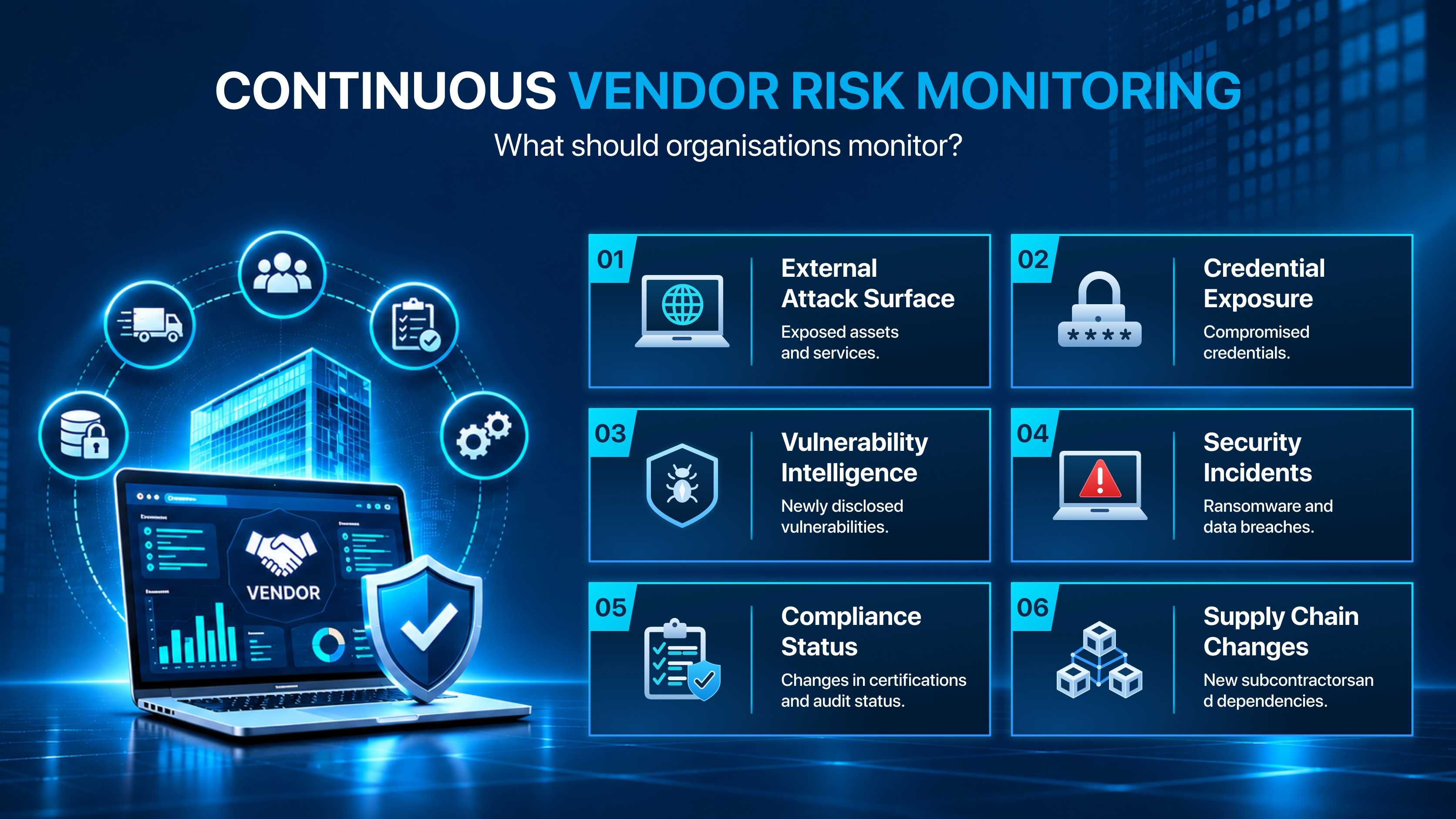
Continuous vendor risk monitoring adds an ongoing layer of visibility into developments that may affect a provider's security posture.
Monitoring activities should include:
-
External Attack Surface Changes: Identify newly exposed internet-facing assets, services, domains and infrastructure associated with a vendor. Changes in exposed services or configurations may indicate an expansion of the attack surface.
-
Credential Exposure: Monitor relevant threat intelligence sources for compromised credentials, leaked authentication material and exposed information associated with vendor personnel or infrastructure.
-
Vulnerability Intelligence: Correlate newly disclosed vulnerabilities with technologies and software components used by the vendor. Prioritisation should consider exploitability, exposure and potential business impact.
-
Threat Intelligence and Security Incidents: Track credible reports of ransomware activity, data breaches and other security incidents that may affect the provider or its dependencies.
-
Compliance and Assurance Status: Monitor changes in relevant certifications, audit status and assurance documentation, including expiry or withdrawal where applicable.
-
Supply Chain Changes: Identify changes in material subcontractors, service dependencies and technology providers that could alter the risk profile.
Fortinet's FortiRecon provides an industry example of external exposure and vendor risk monitoring, including visibility into attack surface exposure, ransomware incidents and leaked data.
Monitoring signals should not automatically be treated as confirmed vulnerabilities or evidence of compromise. Findings require validation, contextual risk assessment and appropriate escalation.
For example, a newly exposed service may be legitimate, but it should still be evaluated for ownership, business purpose, configuration and potential attack exposure.
The value of continuous monitoring lies in connecting external signals with vendor criticality, existing control assessments and remediation workflows.
The Role of Third-Party Risk Management Solutions
As vendor ecosystems expand, spreadsheet-based assessments and email-driven evidence collection become increasingly difficult to govern.
Security teams need a consistent method to manage vendor inventories, assessment frameworks, evidence, control gaps, risk ratings and remediation activities.
Third-party risk management solutions can centralise these processes and provide a more structured view of vendor security posture.
Depending on the platform, capabilities may include:
-
Centralised vendor inventories and risk classification.
-
Configurable assessment frameworks.
-
Automated assessment distribution and workflow management.
-
Evidence collection, review and documentation.
-
Identification of control gaps and critical non-conformities.
-
Risk scoring and assessment status tracking.
-
Remediation ownership and deadline management.
-
Continuous monitoring and security posture updates.
-
Management reporting and audit trails.
Automation can reduce repetitive administrative work and improve consistency across vendor assessments. It can also help security teams identify incomplete reviews, overdue assessments and unresolved findings.
However, automation does not replace risk ownership or technical judgement. Security teams must still validate evidence, assess control effectiveness, interpret findings and determine whether residual risk is acceptable.
The platform should support risk-based decisions, not simply generate assessment scores.
How TechOwl Shield Strengthens Third-Party Risk Management
Managing a large vendor ecosystem requires more than distributing questionnaires and collecting compliance documents. Organisations need a consistent mechanism to assess providers, identify control deficiencies and maintain oversight throughout the vendor lifecycle.
TechOwl Shield's Third-Party Risk Management capabilities support this process through structured assessments, AI-assisted analysis and centralised vendor oversight.
The platform supports:
-
Assessment Framework Generation: Generate assessment frameworks based on vendor profiles, risk considerations and applicable compliance requirements. This helps align assessment scope with the nature of the service and the provider's risk profile.
-
AI-Assisted Response Analysis: Analyse vendor assessment responses to identify potential control gaps, critical non-conformities and areas requiring further review. This helps teams prioritise responses that need additional scrutiny.
-
Centralised Vendor Visibility: Maintain vendor information, assessment progress and identified findings through a central dashboard, providing a consolidated view of assessment activity.
-
Lifecycle Tracking: Track vendor assessment activities and related findings throughout the relationship, supporting more consistent oversight beyond initial onboarding.
-
Reporting and Audit Records: Organise assessment findings and supporting records to facilitate internal reviews, risk reporting and audit requirements.
These capabilities help security, risk and compliance teams bring vendor assessment activities into a structured workflow and improve visibility across external dependencies.
Explore TechOwl Shield TPRM to see how your organisation can strengthen vendor assessment and monitoring.
Secure Your Vendor Ecosystem with a Proactive Cybersecurity Strategy
An organisation's cybersecurity boundary extends beyond the infrastructure it owns and operates. Every external provider with access to its systems, data or critical business processes introduces a dependency that must be governed.
A mature Third-Party Cybersecurity Risk Management programme combines vendor discovery, risk classification, technical control assessment, evidence validation, remediation governance and continuous monitoring.
Its effectiveness depends on the ability to identify changes in exposure, evaluate their potential impact and ensure that security findings lead to measurable corrective action.
Start with an accurate vendor inventory. Assess providers according to their risk. Validate security controls. Track remediation to closure. Monitor critical dependencies and enforce access revocation when relationships end.
An approved vendor should never become an unmanaged attack path.
Strengthen your vendor oversight with TechOwl Shield TPRM.
Frequently Asked Questions
1. What is Third-Party Cybersecurity Risk Management?
Third-Party Cybersecurity Risk Management is the process of identifying, assessing, mitigating and monitoring security risks introduced by external vendors, service providers, subcontractors and technology partners. It helps organisations evaluate external access, data handling, security controls and supply chain dependencies throughout the vendor lifecycle.
2. What are the biggest cybersecurity risks associated with third-party vendors?
Common risks include compromised vendor credentials, excessive privileged access, insecure API integrations, vulnerable software components, inadequate data protection, unmonitored subcontractors and delayed incident notification. These weaknesses can expose connected systems and sensitive information or disrupt critical business operations.
3. How often should organisations conduct vendor risk assessments?
Assessment frequency should be based on vendor criticality, data sensitivity, system access and operational dependency. Critical vendors may require continuous monitoring and periodic reassessment, while lower-risk suppliers can follow scheduled reviews. Significant changes, such as new integrations, subcontractors, security incidents or expanded access, should also trigger reassessment.
4. What is the difference between third-party risk and fourth-party risk?
Third-party risk originates from an organisation's direct vendors and service providers. Fourth-party risk originates from the subcontractors, cloud providers, software suppliers and other dependencies used by those direct vendors. Effective supply chain security requires visibility into both levels, particularly where downstream providers process sensitive information or support critical services.
5. How can third-party risk management solutions improve vendor security?
Third-party risk management solutions centralise vendor inventories, assessment workflows, evidence collection, control gap identification, remediation tracking and reporting. Depending on their capabilities, they can also support continuous monitoring and AI-assisted assessment analysis. These tools improve visibility and process consistency while enabling security teams to prioritise vendor risks and track corrective actions.
Sources and Further Reading
-
CERT-In: Comprehensive Cyber Security Audit Policy Guidelines, 2025
-
DSCI: State of Cybersecurity Readiness in BFSI Sector India, 2026
-
RBI: Commercial Banks, Managing Risks in Outsourcing Directions, 2025
Regulatory note: CERT-In guidance, RBI directions and NIST publications have different scopes and legal status. The RBI 2026 cybersecurity framework cited here applies to specified commercial banks, while its 2025 outsourcing directions govern arrangements within their defined scope. Organisations should refer to the latest requirements applicable to their sector, regulatory classification and outsourcing arrangements.