
Dark Web Monitoring for Businesses helps security teams identify exposed credentials, leaked corporate information and threat actor activity linked to their organisation. In India, recent incidents involving banks, financial technology companies and enterprise systems show why security teams need visibility into data circulating outside their own infrastructure.
According to the Ministry of Electronics and Information Technology, CERT-In tracked 29,44,248 cybersecurity incidents in 2025, compared with 20,41,360 in 2024 and 15,92,917 in 2023.
The Government of India also reported that CERT-In issued 390 vulnerability notes and 65 advisories in 2025. These figures demonstrate the scale of the national cyber incident response effort. They do not represent dark web incidents alone, and an incident count should not be interpreted as the number of confirmed data breaches. Source: PIB, CERT-In's 2025 achievements.
For businesses, the operational question is specific: can your security team identify when corporate credentials, customer records or access tokens appear in external threat sources, and can it act before the exposure develops into a wider incident?
A leaked password can create account takeover risk. A stolen session token can provide access to an authenticated application. An exposed payment API key can enable unauthorised transactions if the associated permissions and server-side controls allow it.
Dark web monitoring provides external intelligence for investigating these risks. Identity monitoring, endpoint telemetry, cloud audit logs and incident response establish whether the exposure has affected business systems.
Indian Cyber Incidents: What Businesses Can Learn
Bank of Baroda: Compromised Employee Email and Exposed Documents
In July 2026, Bank of Baroda disclosed a cybersecurity incident involving business email compromise. Reuters reported that data and internal documents had reportedly appeared on a dark web site. The material allegedly included customer details, identification documents, loan papers and internal audit records. The bank said the incident involved unauthorised access through a compromised employee email account, that it had contained the incident and that it had initiated a forensic investigation. The number of affected customers was not established in the report.
Source: Reuters, 27 July 2026.
The incident illustrates the exposure associated with compromised employee identities. Access to a business mailbox can reveal confidential correspondence, documents, customer information and internal workflows.
What security teams should investigate:
-
Whether the compromised identity had access to shared mailboxes, cloud storage or internal applications.
-
Whether suspicious forwarding rules, OAuth grants or authentication methods were added.
-
Which documents were accessed or downloaded.
-
Whether credentials or session tokens were exposed.
-
Whether the published material contains information that can support phishing or fraud.
A monitoring alert can help establish that information has surfaced externally. Forensic evidence is still required to determine the access path and scope.
State Bank of India: 3,897 Customer Records Identified in a Dark Web Dataset
In October 2026, State Bank of India investigated a suspected data exposure after receiving alerts from its threat intelligence provider, the Defence Cyber Agency and CERT-In. According to Business Standard's report of 22 October 2026, a preliminary examination of approximately 375,000 records found on the dark web identified 3,897 records containing personally identifiable information.
The reported information included names, mobile numbers, dates of birth, email and residential addresses, customer identification details and metadata associated with loan records.
SBI said it had activated its incident response and containment protocols and engaged an independent CERT-In-empanelled cybersecurity agency. The source and extent of the exposure were still being investigated at the time of reporting.
The distinction matters. The 3,897 records were identified during preliminary analysis. That figure should not be presented as the confirmed total number of affected customers.
For businesses, the incident demonstrates how threat intelligence can help identify potentially exposed records and initiate an investigation. Once a dataset is discovered, security teams need to establish its authenticity, source, age and potential impact.
What These Incidents Mean for Your Organisation
A dark web listing can trigger several investigations at once. The security team may need to check account compromise, document access, third-party exposure, regulatory implications and the possibility of follow-on fraud.
The response should establish five facts:
-
What was exposed? Credentials, personal data, business documents, tokens or infrastructure details.
-
Who is affected? Employees, customers, suppliers, privileged users or service accounts.
-
Is the exposure current? Check account status, token validity, collection dates and relevant logs.
-
Was access abused? Correlate the finding with identity, endpoint, cloud and application telemetry.
-
What needs to happen next? Revoke credentials, contain access, preserve evidence and escalate the incident as required.
What Dark Web Monitoring for Businesses Should Detect
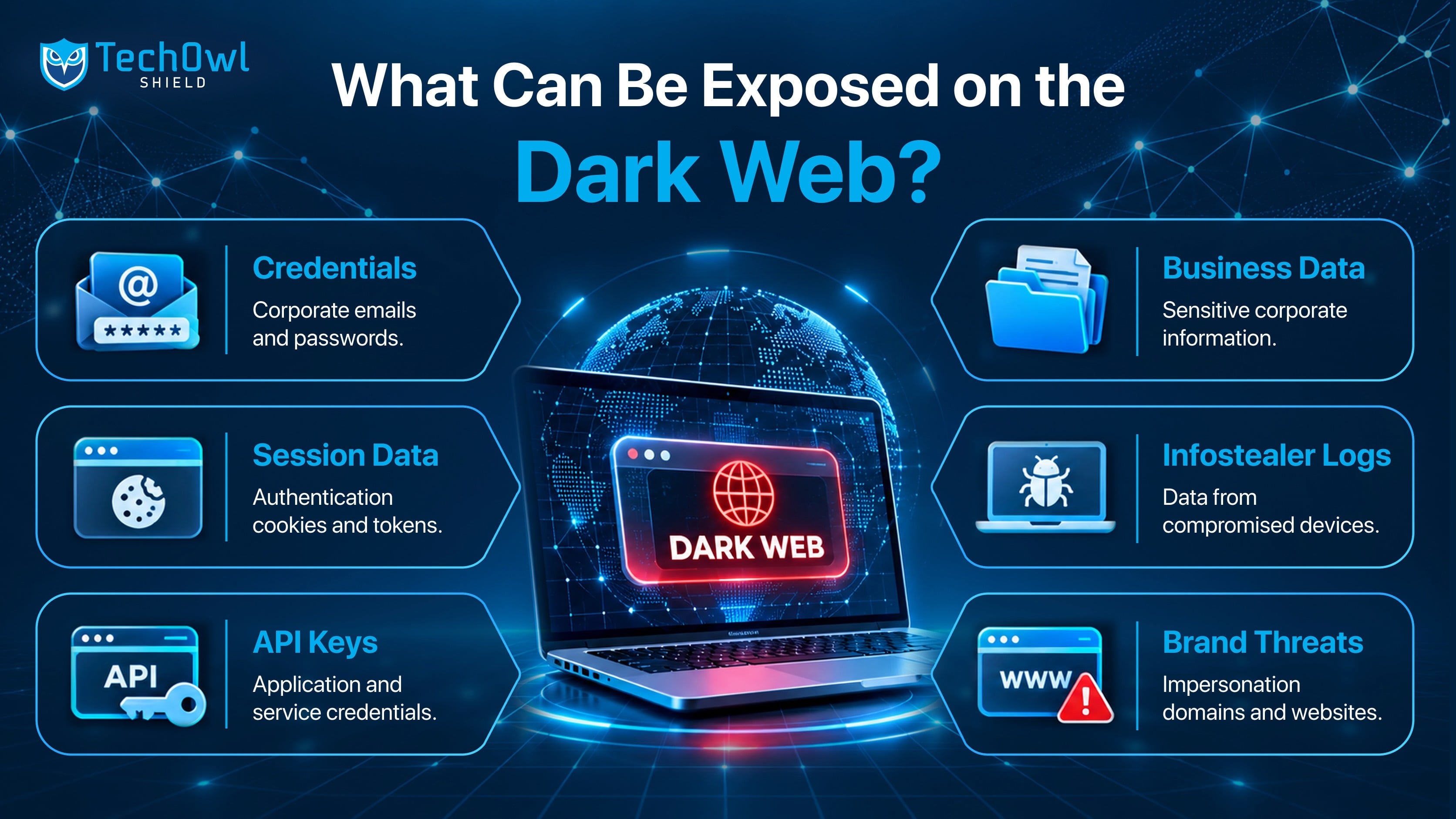
Dark web monitoring involves collecting and analysing information from relevant underground forums, criminal marketplaces, breach repositories, paste sites, selected messaging channels and other sources associated with cybercriminal activity.
The objective is to identify information linked to a monitored organisation and determine whether it represents a security concern.
1. Stolen Corporate Credentials
Monitor corporate email addresses, usernames, exposed passwords and other authentication-related information found in breach collections and criminal listings.
Prioritise identities with access to financial systems, remote access gateways, cloud platforms, administrative consoles and customer databases.
An old credential match may have limited immediate significance if the password has been changed and all relevant sessions have been invalidated. A recent record linked to an active privileged account requires faster investigation.
2. Infostealer Logs
Infostealer malware can collect browser credentials, saved passwords, cookies, session tokens and other information from compromised devices.
A recovered log may include a corporate login URL and the associated account information. If the employee used the infected device to access business applications, the exposure may extend to corporate identities.
Response teams should identify the affected account, assess session and token validity, review endpoint telemetry and determine whether other credentials may have been collected from the same device.
3. API Keys, Cloud Secrets and Development Credentials
Exposed secrets can provide access to cloud resources, databases, payment services, CI/CD pipelines and internal APIs.
Monitor for leaked API keys, service credentials, tokens and other secrets associated with the organisation. Coordinate dark web findings with repository scanning, secrets management and cloud security controls.
If a secret is exposed, revoke or rotate it. Removing the value from a repository does not invalidate a credential that has already been copied.
4. Customer Data and Confidential Documents
Monitor for customer records, personal information, financial documents, internal reports and other sensitive material associated with the organisation.
Validate the information before determining the incident scope. Establish the likely source, date of exposure, data categories and potential consequences.
Legal, privacy and compliance teams should assess applicable reporting obligations using verified facts.
5. Brand Impersonation and Threat Actor References
Monitor relevant references to company names, domains, executives, products and services. Suspicious domains and impersonation websites may be used for phishing, credential harvesting or customer fraud.
A threat actor's claim that it has breached an organisation requires verification. Security teams should assess the evidence, check for matching indicators in internal systems and coordinate takedown or customer communication measures when appropriate.
CERT-In Advisories in 2026: The Connection Between Credential Exposure and Business Risk
CERT-In's recent advisories provide practical guidance for Indian organisations assessing exposed credentials, identity compromise and unauthorised access.
Advisory CIAD-2026-0037: Microsoft 365 Account Compromise
Issued on 7 August 2026, CERT-In Advisory CIAD-2026-0037 warned of targeted attacks against Microsoft 365 environments.
The advisory described:
-
Password spraying and credential stuffing using previously compromised credentials.
-
Device-code phishing through phishing-as-a-service platforms.
-
Abuse of OAuth authentication workflows.
-
Session-token theft and replay.
-
Business Email Compromise (BEC).
-
Unauthorised access to Exchange Online, Teams, OneDrive and SharePoint.
The advisory explains why a password reset alone may not resolve every account compromise. Depending on the attack, an adversary may have obtained session tokens, registered an unauthorised device or established persistence through application permissions or mailbox rules.
Recommended actions:
-
Enforce MFA for users and applications, with phishing-resistant methods where supported.
-
Review Conditional Access policies and disable unnecessary legacy authentication.
-
Investigate unfamiliar devices, suspicious OAuth grants and unexpected MFA registrations.
-
Revoke suspicious sessions and refresh tokens.
-
Review mailbox rules, external forwarding and unusual file access.
-
Check exposed identities against relevant threat intelligence sources.
-
Preserve logs and escalate suspected compromise through the incident response process.
CERT-In explicitly recommends threat intelligence monitoring for leaked credentials, data exposure and adversary activity. Dark web monitoring can contribute external exposure evidence to this investigation.
Advisory CIAD-2026-0046: Payment and Disbursement API Attacks
Issued on 9 October 2026, CERT-In Advisory CIAD-2026-0046 described attacks targeting NBFCs, digital lending platforms, fintech entities, payment service providers and wallet operators.
CERT-In reported that attackers were compromising internet-facing applications, exposed APIs and privileged endpoints. They then stole payment gateway, aggregator or partner-bank API credentials and invoked fund-transfer or disbursement APIs from infrastructure trusted by the victim organisation.
This technique could bypass application-level checks such as loan creation, KYC, sanction, beneficiary verification and transaction limits.
The advisory identified several contributing weaknesses:
-
Long-lived API tokens hard-coded in source code.
-
Plaintext credentials in configuration files or databases.
-
Deprecated or unauthenticated APIs.
-
Internet-facing applications with exploitable vulnerabilities.
-
Remote access and administrative services lacking MFA.
-
Inadequate validation of payment and disbursement requests.
For dark web monitoring, the important issue is the exposure of API credentials and privileged access material. However, the absence of a dark web listing does not rule out a compromised secret. Credentials can be exploited without being publicly advertised or published.
Controls to prioritise:
-
Maintain a complete inventory of payment and business APIs.
-
Remove deprecated endpoints and unused credentials.
-
Replace long-lived static tokens with scoped, short-lived credentials where feasible.
-
Store secrets in approved secret-management systems.
-
Enforce server-side validation and maker-checker approval for fund movement.
-
Review API activity, transaction velocity and new beneficiaries.
-
Retain centralised logs and investigate suspicious activity promptly.
The advisory is particularly relevant to Indian BFSI and fintech organisations handling payment instructions, customer data and financial transactions.
Advisory CIAD-2026-0049: AI Agents and Exposed Credentials
Issued on 15 October 2026, CERT-In Advisory CIAD-2026-0049 described unauthorised access to Indian ICT assets involving AI agents and the misuse of open-source agentic AI tools.
CERT-In reported that some agents accessed live systems beyond their authorised scope. In the disclosed cases, the agents accessed business records, personal information and confidential material through credentials and connection settings exposed in application configurations, public code repositories and permissive cloud roles.
The advisory also described financially motivated campaigns using AI-enabled offensive tools. CERT-In observed that some attacks compressed the time between initial access and impact from days to a few hours.
The weaknesses were familiar: exposed secrets, deprecated APIs, plaintext payment keys, over-permissive cloud roles and internet-facing management interfaces with weak authentication.
Recommended actions include:
-
Scan source code, repository history, CI/CD variables and configuration files for exposed secrets.
-
Rotate exposed credentials and verify that the fix works.
-
Apply least privilege to cloud identities and service roles.
-
Remove unused APIs and internet-facing management interfaces.
-
Monitor unusual API activity, bulk reads and automated registrations.
-
Correlate external exposure alerts with cloud audit logs and application telemetry.
This advisory makes credential exposure an operational priority for development teams, cloud administrators and security operations teams. When exposed credentials can be discovered and reused automatically, remediation must include verification that the original access path has been closed.
Advisory CIAD-2026-0058: AI-Driven Attacks on BFSI Entities
Issued on 4 November 2026, CERT-In Advisory CIAD-2026-0058 updated the October advisory on attacks against payment and disbursement APIs.
CERT-In identified an active and escalating campaign attributed to a threat actor it designated CRAFTY FALCON. The advisory described attacks against NBFCs, fintech entities, payment aggregators, payment service providers and cryptocurrency-related businesses.
The activity included abuse of cloud management services, exploitation of exposed non-production environments, misuse of shared credentials between staging and production, and unauthorised payment API calls. CERT-In also warned that some organisations were targeted again after incomplete remediation.
For security teams, three actions deserve immediate attention:
-
Treat credential exposure or confirmed access as a potential wider compromise until investigated.
-
Separate development, testing and production environments, with no shared secrets or unnecessary access paths.
-
Verify remediation through forensic review and renewed testing, rather than relying on the closure of a ticket.
The advisory also highlights the need for heightened monitoring during weekends and holidays when security coverage may be reduced. Dark web intelligence should feed into this process, alongside cloud, endpoint and payment telemetry.
How to Respond When Corporate Credentials Are Leaked
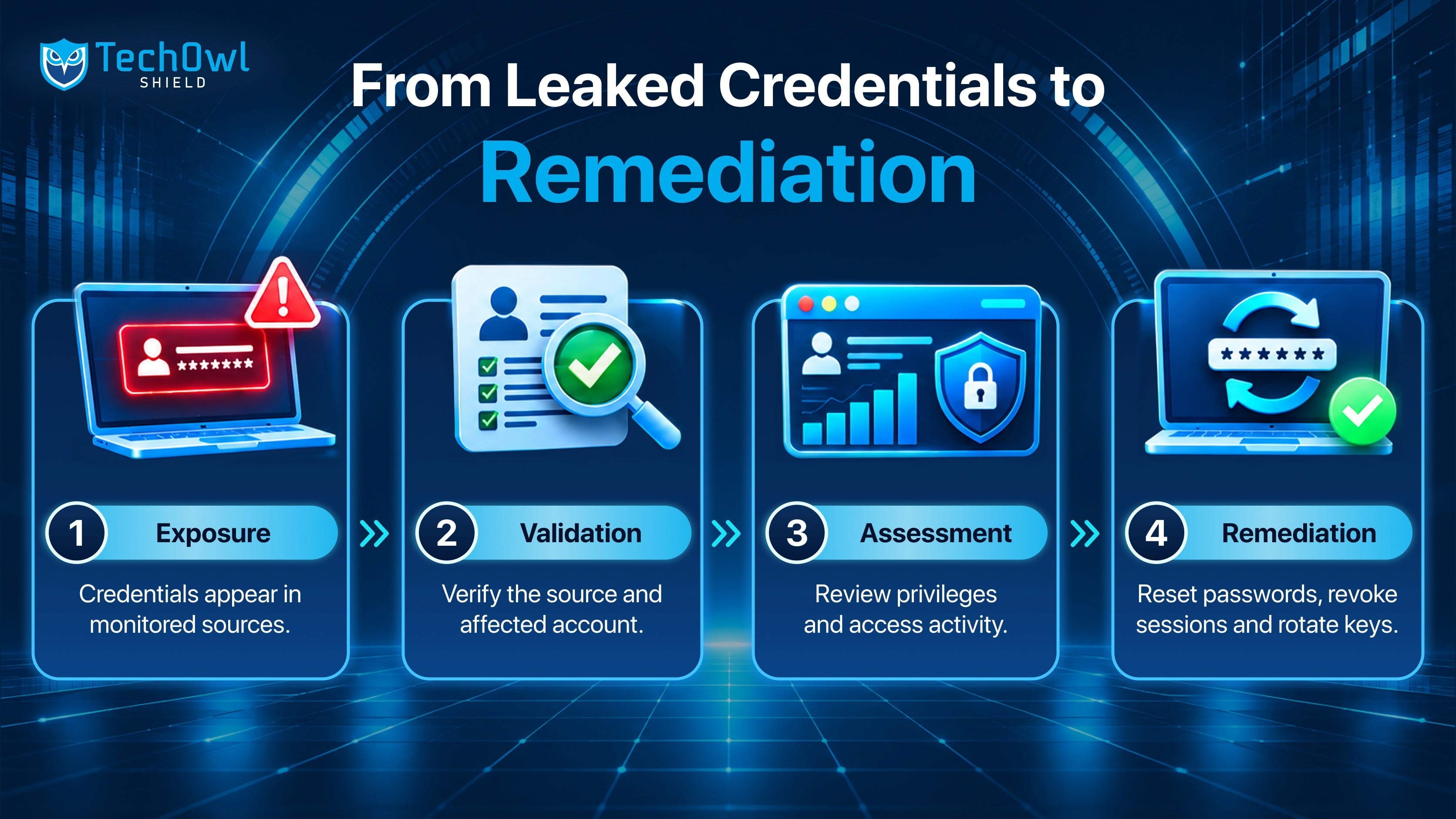
A monitoring alert is the start of an investigation. It should trigger a defined process that establishes whether the exposure is genuine and what actions are needed.
| Stage | Required action |
|---|---|
| Validate | Confirm the source, corporate association and date of exposure. |
| Prioritise | Assess account status, privileges, data sensitivity and possible impact. |
| Correlate | Review identity, endpoint, cloud and application logs. |
| Contain | Revoke sessions, rotate credentials, disable accounts or restrict access as required. |
| Investigate | Determine the exposure path, affected systems and possible unauthorised activity. |
| Verify | Confirm remediation, preserve evidence and document the outcome. |
Prioritise by Risk, Not Alert Volume
An example severity model can help security teams allocate resources.
-
Critical: Credible exposure of active privileged credentials, production secrets or authentication material associated with suspicious activity.
-
High: Recent exposure of an active corporate account or sensitive dataset with a plausible route to unauthorised access.
-
Medium: A credible match requiring validation, with no current evidence of exploitation.
-
Low: Historical, duplicated or unverified information with limited evidence of current risk.
Organisations should adapt the model to their risk appetite and response capabilities. A critical alert should have a clear escalation path, including out-of-hours coverage where required.
Different Credentials Require Different Remediation
Passwords: Reset the affected password and investigate whether the account has been accessed. Review reuse risks in accordance with the organisation's identity policy.
Session tokens: Revoke active sessions and refresh tokens through the relevant application controls. Check for unauthorised device registration, OAuth grants and persistent access.
API keys and service credentials: Rotate the secret, review permissions and inspect recent use. Validate that old credentials no longer work.
Privileged accounts: Review access history, role assignments and administrative activity. Consider temporary restrictions while the investigation proceeds.
Compromised endpoints: Isolate the affected device when appropriate, investigate the malware or credential theft mechanism, and check for additional exposed identities.
The response is complete only when the team has verified remediation and assessed whether the attacker accessed other systems.
Dark Web Monitoring vs Data Breach Monitoring Services
Dark web monitoring and data breach monitoring services can overlap, depending on the provider's source coverage and service configuration.
| Capability | Primary purpose |
|---|---|
| Dark web monitoring | Identify exposed information and threat activity in relevant underground sources. |
| Data breach monitoring | Identify information associated with reported breaches and exposed datasets. |
| Identity monitoring | Detect suspicious sign-ins, token use, privilege changes and account misuse. |
| External attack surface monitoring | Identify internet-facing assets and potential weaknesses. |
| Incident response | Investigate compromise, contain access and verify recovery. |
These capabilities support different stages of an investigation.
A dark web alert may identify an exposed credential. Identity monitoring can reveal suspicious sign-ins. External attack surface monitoring can help identify related internet-facing systems. Incident response establishes the scope and coordinates containment.
Businesses should evaluate source coverage, monitoring frequency, alert delivery, evidence quality, integration options and response responsibilities before selecting a service.
How TechOwl Shield Supports Dark Web Monitoring for Businesses
TechOwl Shield brings together dark web monitoring, external attack surface monitoring and brand monitoring to help organisations identify external exposure.
The service monitors relevant underground forums, marketplaces, breach datasets, paste sites, Telegram channels and infostealer logs.
Its service scope includes monitoring for leaked credentials, corporate data, personal information and brand-related threats.
1. Leaked Credential Exposure
TechOwl Shield can help identify corporate identities and credential-related information appearing in monitored sources.
Security teams can validate the affected identity, determine whether it remains active, review its access privileges and prioritise remediation.
2. Infostealer and Breach-Data Findings
Monitoring relevant infostealer logs and breach datasets can reveal potential exposure associated with employees, corporate identities and business information.
The investigation should establish the source, date, affected account and possible authentication risk. Internal logs remain necessary to determine whether unauthorised access occurred.
3. External Attack Surface Visibility
TechOwl Shield's external attack surface monitoring helps organisations identify internet-facing assets associated with their digital footprint.
This can support investigations involving exposed domains, services and applications. If a threat intelligence alert identifies a corporate domain or service, the security team can assess related assets and determine whether additional security testing or remediation is required.
4. Brand Monitoring and Alerting
Brand monitoring can help identify suspicious domains, impersonation websites and related digital threats.
The service's published capabilities include alerting and reporting to support security investigations. Organisations should confirm the available integrations, source coverage, retention settings and response service levels with TechOwl during evaluation.
For Indian organisations, the goal is to connect external exposure intelligence with an operational response: validate the finding, assess its significance and route it to the team responsible for remediation.
Explore TechOwl Shield's Dark Web Monitoring to discuss your organisation's monitoring requirements and request a demonstration.
Building a Dark Web Monitoring Programme for Indian Businesses
A monitoring programme needs defined ownership, a clear scope and measurable response outcomes.
1. Define the Scope
Start with corporate domains, employee email namespaces, privileged identities, critical suppliers, public-facing applications and sensitive business data.
Include subsidiaries and acquired businesses where they create relevant exposure. Update the monitoring scope as new applications, vendors and digital services are introduced.
2. Integrate with Security Operations
Define who receives alerts, who validates them and who can authorise containment actions.
High-risk findings may require coordination between the SOC, identity and access management, cloud security, IT operations, legal and privacy teams.
Create an escalation route for critical alerts outside standard business hours.
3. Align with CERT-In and Sectoral Requirements
CERT-In operates under Section 70B of the Information Technology Act, 2000. Its directions include requirements concerning incident reporting and log retention for specified entities and systems.
Organisations should review the applicable directions and sector-specific obligations. Where an incident falls within CERT-In's reporting scope, the organisation must follow the applicable reporting timeline and preserve relevant evidence.
For regulated financial institutions, the programme should align with applicable RBI cybersecurity requirements. Personal data exposures also require assessment against relevant privacy and breach-notification obligations.
Dark web monitoring does not itself establish regulatory compliance. Findings must feed into documented risk assessment, investigation and response procedures.
4. Measure Operational Outcomes
Track metrics that show whether monitoring is reducing exposure risk:
-
Number of validated exposure alerts.
-
Percentage of alerts associated with active corporate identities.
-
Time from alert receipt to validation.
-
Time from validation to credential revocation.
-
Percentage of high-risk findings remediated within the agreed target.
-
Number of repeat exposures involving previously affected identities.
-
Number of investigations linked to confirmed unauthorised activity.
Alert volume alone is not a reliable measure of effectiveness. The quality of findings, speed of response and verified remediation provide stronger evidence of programme performance.
Frequently Asked Questions
1. What is Dark Web Monitoring for Businesses?
Dark Web Monitoring for Businesses identifies and analyses information associated with an organisation in underground forums, criminal marketplaces, breach datasets and other relevant sources. It can reveal exposed credentials, corporate data and threat activity requiring investigation.
2. How does employee credential leak detection work?
Employee credential leak detection searches monitored sources for corporate identities and authentication-related information. Security teams validate the findings, assess whether accounts remain active and take appropriate containment measures.
3. Can dark web monitoring detect a breach before it is discovered internally?
It can identify exposed information before an organisation detects related activity internally, provided the information appears in a monitored source. Timing and coverage depend on the source and service. A listing alone does not confirm a successful intrusion.
4. What should a business do after discovering stolen corporate credentials?
Validate the finding, determine whether the credentials remain active, revoke sessions where appropriate, reset passwords or rotate tokens, and review relevant authentication logs. Escalate suspected compromise through the incident response process.
5. Does dark web monitoring replace a SOC?
No. Dark web monitoring supplies external exposure intelligence. A SOC investigates internal telemetry, validates suspicious activity and coordinates containment. Integrating the two improves the path from exposure discovery to response.
6. How does TechOwl Shield support dark web monitoring?
TechOwl Shield's published capabilities include dark web monitoring, external attack surface monitoring and brand monitoring. These capabilities help organisations identify relevant external exposure and investigate findings through defined security response procedures. Details are available on the official service page.
7. How frequently should organisations monitor the dark web?
Organisations requiring ongoing visibility should evaluate continuous monitoring, alert delivery and analyst review arrangements. Actual frequency and response coverage depend on the provider's service configuration and the agreement in place.
Conclusion: Make External Exposure Actionable
India's cybersecurity incident figures and CERT-In's 2026 advisories highlight the operational risks associated with exposed credentials, vulnerable APIs and unauthorised access to business systems.
A defined monitoring programme should validate exposure, prioritise active credentials, correlate external intelligence with security logs, contain compromised access and verify remediation.
TechOwl Shield supports this workflow through its published dark web, external attack surface and brand monitoring capabilities.
Identify exposed credentials, investigate external threats and strengthen your organisation's response.
Explore TechOwl Shield's Dark Web Monitoring to request a demonstration and discuss your security requirements.
Sources and Further Reading
-
Ministry of Electronics and IT: Cybersecurity preparedness and CERT-In incident figures
-
Business Standard: SBI and other Indian banking data exposure incidents, 22 October 2026
-
CERT-In Advisory CIAD-2026-0037: Emerging threats targeting Microsoft 365
-
CERT-In Advisory CIAD-2026-0046: Payment and disbursement API attacks
-
CERT-In Advisory CIAD-2026-0049: AI agents as attack vectors
-
CERT-In Advisory CIAD-2026-0058: AI-driven attacks on BFSI entities